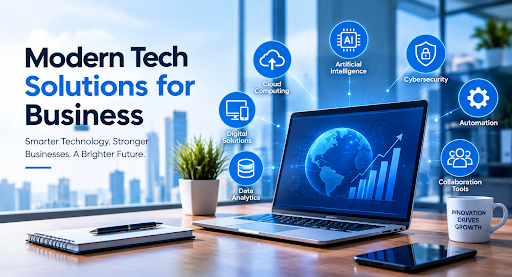
Technology is changing the way businesses operate, communicate with customers, and compete in the modern marketplace. From small startups to large organizations, companies are adopting digital tools to improve productivity, reduce unnecessary costs, protect important information, and deliver better customer experiences.
Modern tech solutions for business are no longer limited to advanced corporations with large technology departments. Cloud platforms, artificial intelligence, automation, data analytics, cybersecurity, and digital communication tools are now accessible to businesses of different sizes. When used strategically, these technologies can help organizations work smarter and respond more effectively to changing customer expectations.
However, successful technology adoption is not about purchasing the latest tools. Businesses need to understand their specific challenges and select solutions that provide practical and measurable benefits.
What Are Modern Tech Solutions for Business?
Modern tech solutions for business include digital tools, software, platforms, and systems that help companies improve their everyday operations. These solutions can support areas such as sales, marketing, customer service, finance, communication, data management, cybersecurity, and employee productivity.
For example, a business can use cloud software to access important files from different locations, CRM software to organize customer information, and automation tools to reduce repetitive administrative work. Data analytics can help managers understand business performance, while cybersecurity solutions can protect digital assets.
The best technology is technology that solves a genuine business problem rather than technology adopted simply because it is popular.
Why Businesses Need Modern Technology
Traditional business processes can become inefficient as a company grows. Manual data entry, paperwork, disconnected applications, and repetitive tasks can consume valuable employee time and increase the risk of errors.
Modern technology can simplify these processes. Digital systems allow information to be organized more efficiently, while automation can handle repetitive activities. Employees can communicate more easily, and managers can access useful information to make informed decisions.
Technology also plays an important role in customer expectations. Modern customers often want quick responses, convenient online services, secure payments, and personalized experiences. Businesses that use technology effectively can meet these expectations while building stronger relationships with their customers.
Cloud Computing for Business
Cloud computing has become one of the most useful technologies for modern businesses. Instead of depending entirely on physical servers and office computers, companies can use internet-based platforms to access software, storage, and computing resources.
Cloud technology provides flexibility because employees can access approved systems and information from different locations. This makes it especially useful for remote and hybrid workplaces.
It can also support business growth. Companies can increase or reduce their technology resources according to their requirements without making large investments in physical infrastructure.
Artificial Intelligence and Business
Artificial intelligence is becoming an important part of modern business operations. AI can help organizations analyze information, automate specific tasks, assist customers, identify patterns, and support decision-making.
Businesses can use AI for customer service, data analysis, forecasting, document processing, recommendations, and other activities. When properly implemented, AI can save time and help employees focus on more valuable responsibilities.
At the same time, businesses should use AI responsibly. Human oversight, data accuracy, privacy, and security should remain important considerations when introducing AI into business processes.
Business Automation
Many organizations spend considerable time performing repetitive tasks. Automation allows software to complete certain predefined activities with limited manual involvement.
For example, businesses can automate routine notifications, invoice processing, appointment reminders, report generation, and workflow approvals. This can reduce administrative workloads and allow employees to focus on creative and strategic responsibilities.
Automation can also improve consistency because standardized processes are less dependent on manual intervention.
Customer Relationship Management
Customer relationships are essential for long-term business success. As the number of customers increases, managing their information and communication can become difficult.
Customer relationship management, or CRM, systems provide businesses with a centralized place to manage customer information, sales opportunities, communications, and support interactions.
A well-managed CRM system can help sales and customer service teams understand customer history and provide more consistent experiences. It can also give managers better visibility into sales activities and customer engagement.
Data Analytics and Business Intelligence
Businesses generate large amounts of data through sales, websites, customer interactions, marketing campaigns, and internal operations. Without proper analysis, much of this information may remain unused.
Data analytics tools can transform raw information into useful business insights. Companies can analyze sales trends, customer behavior, marketing performance, operational costs, and other important areas.
These insights can help managers make decisions based on actual information instead of relying entirely on assumptions. Data does not replace human judgment, but it can provide a stronger foundation for strategic planning.
Cybersecurity for Modern Businesses
As businesses become increasingly digital, protecting information and systems is more important than ever. Cybersecurity helps organizations reduce the risk of unauthorized access, data loss, fraud, and other digital threats.
Businesses should consider measures such as strong passwords, multi-factor authentication, access controls, secure backups, software updates, employee training, and appropriate monitoring.
Cybersecurity should be treated as an ongoing business responsibility rather than a one-time investment. Employees also need to understand common security risks because human mistakes can create vulnerabilities.
Digital Communication and Collaboration
Remote and hybrid working have increased the importance of digital communication. Businesses can use video conferencing, instant messaging, shared documents, and project management platforms to keep teams connected.
These tools allow employees to collaborate even when they are working from different locations. They can also improve information sharing and reduce communication delays.
However, businesses should avoid using too many platforms for similar purposes. A simple and well-organized technology environment is usually easier for employees to manage.
How to Choose the Right Technology
Businesses should begin by identifying a specific problem before investing in a technology solution. Clear goals make it easier to determine whether a particular tool is actually useful.
Cost, scalability, security, ease of use, integration, and long-term support should all be considered. A solution should work with existing systems whenever possible and have enough flexibility to support future growth.
Employee training is equally important. Even the most advanced technology will provide limited value if employees do not understand how to use it effectively.
Benefits of Modern Tech Solutions
The right technology can improve business efficiency, productivity, communication, customer service, and decision-making. Automation can reduce repetitive work, while analytics can provide valuable insights.
Cloud technology can support flexibility, and cybersecurity solutions can help protect important information. Digital customer tools can also make it easier for companies to provide fast and convenient services.
Ultimately, technology can give businesses the ability to adapt more quickly while creating a stronger foundation for sustainable growth.
Conclusion
Modern tech solutions for business are transforming traditional operations and creating new opportunities for growth. Cloud computing, artificial intelligence, automation, CRM systems, analytics, cybersecurity, and digital collaboration tools can help companies become more efficient and competitive.
The key is to choose technology based on actual business needs rather than trends. With careful planning, employee training, and a focus on security, businesses can use modern technology to improve performance, satisfy customers, and prepare for the future.
FAQs
1. What are modern tech solutions for business?
They are digital tools and systems that help businesses improve productivity, communication, customer service, security, and overall operations.
2. How can technology help a small business?
Technology can automate repetitive work, reduce operational costs, improve customer service, and help small businesses manage their operations more efficiently.
3. Is artificial intelligence useful for businesses?
Yes, AI can assist with tasks such as customer support, data analysis, forecasting, and automation while helping employees save time.
4. Why is cloud computing important for businesses?
Cloud computing provides flexible access to software, storage, and business information while supporting remote work and business scalability.
5. How can businesses choose the right technology?
Businesses should identify their needs first and then compare solutions based on cost, security, scalability, usability, integration, and long-term value.