Thanks to artificial intelligence, people are searching the internet in a whole new way. Unlike conventional search engines that focus on text, keywords, and metadata, a face search powered by AI is based on facial features and can identify pictures that may be similar to the one being searched from an indexed online source. These tools can be useful for online research and for investigating suspected impersonation, and they can show where a picture may be found online.
FaceCheck.ID is an example of a facial image search service. It lets users upload an image of a person’s face and search for likely matches among images found online. To grasp how this technology works, one needs to examine computer vision, facial feature extraction, image matching, and the limitations of AI-based search.
What Is AI Face Search?
AI face search is a type of artificial intelligence that detects faces and compares their visual features to images in a searchable database or collection. The system does not need a person’s name or username as input; instead, the face itself is the search input.
It can be helpful when looking into a suspicious profile, researching someone’s online history, checking whether a photo appears on more than one webpage, or exploring the online context of an image.
Facial image search is not a form of identification, though. A system can recognize a picture that looks like another picture without determining whether the two pictures show the same individual, or whether a specific online account belongs to that person.
How FaceCheck.ID Works
FaceCheck ID is not fully public about its internals, but the basic steps of most AI-powered facial search systems are well understood.
Step 1: Uploading a Facial Image
The process starts when a user uploads an image with a visible, detectable face. Image quality affects the usefulness of the search: poor lighting, unusual angles, blurry photos, and partially covered faces make the image harder to process.
Users should be sure they have a valid reason and legal grounds for submitting an image, especially because it may contain another person’s biometric data.
Step 2: Detecting and Analyzing Facial Features
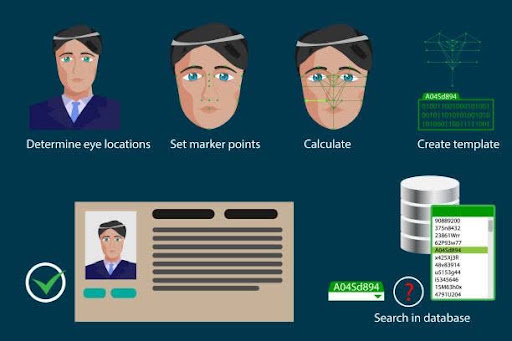
Computer vision models detect the presence of a face in an image and extract its visual attributes. Pre-processing can include resizing the image, centering the face, and cropping the face area out of the background.
The AI model then encodes the facial information into a numerical form called an embedding. This representation contains patterns learned by the system, allowing images to be compared mathematically rather than by names or descriptions.
Step 3: Finding Similar Images
Once the face has a numerical representation, the search system compares the query with the indexed images or with their representations. Some systems use vector similarity calculations and search indexes to retrieve candidate images efficiently. Results are then ranked according to the system’s matching techniques.
FaceCheck.ID can provide possible online facial matches through its service. However, its actual models, similarity calculations, and ranking procedures should not be assumed without verified technical documentation.
Step 4: Reviewing Potential Matches
After a search, users can view the results and the linked websites. The results may reveal where a photograph appears online or serve as a starting point for research.
Each result needs contextual review. A picture might be used by an impersonator, or it might be a copy from another website rather than the original. Similar appearance does not indicate account ownership, nor does it guarantee the accuracy of the information on a webpage.
Common Applications of AI Face Search
When handled properly, AI face search can aid a variety of online research tasks:
- Impersonation investigations: Searching for possible online instances of a picture that may be part of a fake profile.
- Research on similar images: Checking whether the same facial image appears on various pages or websites.
- Digital risk assessment: Helping security teams investigate suspicious profiles alongside other evidence.
- Online identity research: Providing an extra starting point when other identifiers, such as a username, are not available.
These applications work best as a complement to other identity verification techniques and should not be used for actual identification.
Face Search, Facial Recognition, and Deepfake Detection
These technologies are similar but serve different functions.
- AI face search searches for similar faces in a database of facial images.
- Facial recognition typically compares facial features with known faces or enrolled records.
- Deepfake detection analyzes images, videos, or audio for anomalies that may indicate artificial creation or manipulation.
- Liveness detection determines whether a biometric sample comes from a real person rather than a photo, replay, or other presentation attack.
These technologies may be used together, but none can make a correct identification in every case.
Limitations and Privacy Considerations
Accuracy Limitations
Face search AI may return false results or miss images that contain relevant faces. Results depend on image quality, the amount of publicly available material on the internet, model performance, and how recently the indexed web pages were updated.
Privacy and Legal Concerns
Facial images may count as sensitive biometric data, and searching for a person without a proper reason can raise ethical and legal issues. Every user should honor applicable privacy laws, minimize unnecessary data collection, and avoid using unverified matches to make consequential accusations or decisions.
Search results should be supported by other sources of information and sound contextual evidence to reach more robust conclusions.
Conclusion
FaceCheck.ID demonstrates the capabilities of AI facial image search for finding possible matches of a photo across indexed websites. The concepts behind this capability include computer vision, facial embeddings, similarity comparison, and search ranking.
The key is to understand what the technology can and cannot do. While AI face search can offer helpful online research leads, it does not guarantee the accuracy of any findings, including identity, account ownership, or the authenticity of the image searched. Used together with proper verification, privacy awareness, and independent evidence, it can be a powerful component of a responsible digital investigation process.