

Most surgical light decisions go wrong long before anyone compares quotations.
They go wrong at the point where somebody picks a light without checking the ceiling height.
Sounds like a small thing. It isn’t. A low false ceiling rules out entire mounting configurations, and discovering that after the purchase order has been raised means either a redesign or a compromise. Neither is cheap and neither makes anybody happy.
So here’s the sequence the hospitals who get this right actually follow.
Start with the surgeries, not the catalogue
What will this room genuinely run? Not what the department hopes to be doing in five years — what it will be doing in month one.
Cardiac and deep-cavity work wants serious shadow control and depth. Endoscopy needs its own optics entirely. A labour room needs something reliable and uncomplicated, and putting a premium cardiac dome in there is budget that should have gone to the theatre next door.
Match the light to the list and half the decision has made itself.
Then the room
Ceiling height and slab structure decide the mounting — ceiling-mounted, wall-mounted or mobile. The building usually chooses for you, which is why it helps to have the civil drawing before the first vendor meeting rather than after it.
Airflow matters too. If the theatre runs laminar flow, the light body has to be aerodynamically designed for that environment, otherwise you disturb the very air pattern you paid to install. Ventek’s Laminar 54 series exists for those rooms specifically.
And check the existing electrical load while you’re there. Theatres get upgraded in pieces over the years, and the moment somebody discovers the circuit won’t take the addition is almost always the day of installation.
Single dome or double dome
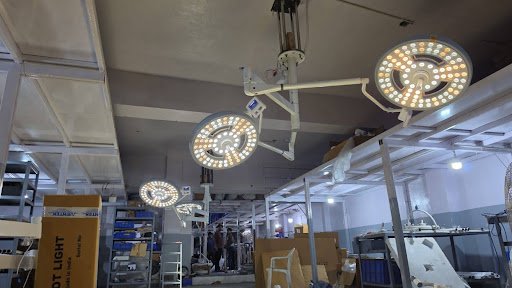
Double dome for major OT, where the field is deep and shadow has to be controlled from several angles. Single dome where access is simple and the field is shallow.
Buying double everywhere is expensive. Buying single everywhere is worse. Most hospitals end up with a mix — which is exactly why the depth of a supplier’s range matters more than the spec of any single model. One vendor across the whole building means one warranty and one service contact, instead of four companies pointing at each other when a fault sits somewhere between two systems.
Now check the company
CDSCO registration in the supplier’s own name, not borrowed from whoever built the unit. US FDA approval if you’re benchmarking internationally or exporting. A GeM listing if you procure through government tender, because without it that route gets complicated fast.
Ask about affiliations as well — AiMeD, FICCI, EEPC India, MSME, NSIC. These aren’t decorative. They tend to indicate a company that’s been trading long enough, and formally enough, to sit inside the industry rather than beside it.
Ventek Care Pvt. Ltd., which also trades as Vandana Surgicals, holds all of the above, along with eighteen-plus years of manufacturing, over 30,000 installations, and 1,150+ distributors across 27 countries — all of it running out of the Bawana plant. Hospitals shortlisting the best OT light manufacturer in Delhi tend to begin on that page, where the series breakdown, the certifications and the NCR coverage sit together.
Ask about service before you ask about price
This step gets skipped constantly. It’s also the one that decides how the next decade feels.
Who installs it? A standard ceiling-mounted double dome should be installed and calibrated inside a day, provided the ceiling anchor and electrical point are ready — and a decent operation theatre light manufacturer in Delhi will send you the pre-installation civil and electrical requirements well in advance so nothing stalls on site. Who services it afterwards? How far away is the nearest engineer, physically, in kilometres? Are spares held in India or ordered in from abroad?
A company with a plant in Bawana and engineers moving across NCR answers those questions very differently from a national distributor with a Delhi phone number. The difference gets measured in days of theatre downtime.
Only now, compare quotations
By this point it’s easy, because you’re finally comparing like with like.
Be a bit suspicious of a fixed rate card, incidentally. Ceiling height, false-ceiling structure, electrical load and procedure mix all change what the right configuration is, so anyone quoting off a price list before asking about your theatre is quoting inventory rather than solving a problem.
Send the theatre dimensions instead and ask for a configuration built against them. The replies sort the vendors faster than any comparison sheet will. One comes back with a considered recommendation and a question about your ceiling. Another sends the same PDF it sends everybody.
The short version
Procedures. Room. Dome configuration. Credentials. Service response. Price last.
Work in that order and the light will still be right in year seven. Work backwards from price and you’ll find out what a false economy looks like somewhere around year three — usually mid-list, usually on a Saturday.