


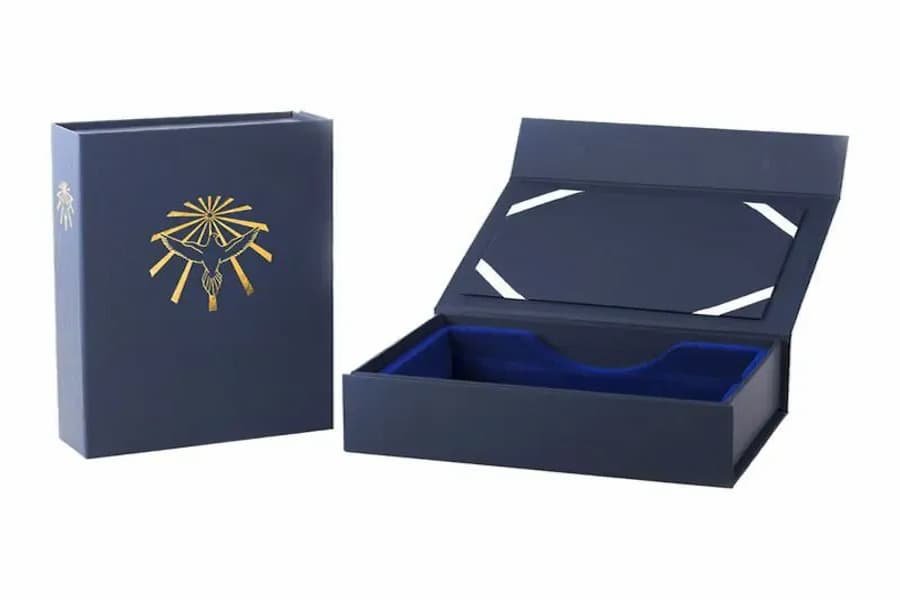
I’ve noticed a lot of business owners lump every rigid box together as “just a fancy box.” Fair enough on the surface, but once you actually hold a booklet-style box next to a standard two-piece rigid box, the difference is obvious within about three seconds. One opens like a lid coming off a shoebox. The other opens like a book. That single difference changes almost everything else about how the box behaves and how it makes a product feel.
So let’s break down where these two actually part ways, and which one might make more sense for whatever you’re packing.
The Way They Open Isn’t a Small Detail
A standard rigid box is the classic setup base at the bottom, lid on top, sometimes it slides off, sometimes you just lift it straight up. It’s dependable. Nothing fancy going on, and for a lot of products, that’s exactly what you want. Electronics, tools, small gift sets nobody needs drama to open a phone case box.
Custom booklet rigid boxes work differently. The front panel is hinged, so it swings open rather than lifting off. Inside there’s usually a tray holding the product, and sometimes a second fold or flap that opens even further, almost like turning a page. It’s not just a packaging style; it changes the pace of the whole interaction. You’re not yanking a lid off you’re opening something.
That matters more than people expect. I’ve talked to brand owners who switched from a plain rigid box to a booklet format purely because customers were filming their unboxings and the “flat lid removal” just didn’t look interesting on camera. A hinged cover swinging open reads as an event. A lid coming off reads as, well, opening a box.
Branding Space Is Where Booklet Boxes Really Win
Here’s the part people underestimate until they see it. A standard rigid box gives you maybe two surfaces to print on the top of the lid and the sides. That’s it, unless you’re adding printed inserts separately.
A booklet box hands you an entire inner cover to work with. Brands use that space for all kinds of things: a short brand story, ingredient breakdowns, usage steps, sometimes just a thank-you message printed where the customer will actually notice it. It’s basically an extra page of real estate that a standard box structure can’t offer without bolting on additional pieces.
Think about the difference between a plain gift box and a magazine that unfolds to reveal a full spread inside. That’s roughly the gap here. If your brand identity depends on storytelling and a lot of them do now this space alone might tip the decision.
Magnetic Closures and That “Premium” Feel
Most booklet-style boxes come with a magnetic closure holding the cover shut until it’s opened. There’s a soft click when it releases, and that tiny bit of resistance genuinely changes how “premium” something feels in someone’s hands. It’s a small trick, but it works think about opening a nice journal or a boutique gift card holder versus popping the lid off a shoebox.
Standard rigid boxes can have magnetic closures too, to be fair. But it’s far more common to see plain friction-fit lids or telescoping designs instead, mostly because the extra hardware and precision folding needed for a magnet-and-hinge setup adds cost that doesn’t always make sense for simpler products.
Structurally, One Is Just Harder to Make Right
Booklet boxes rely on a spine-like fold to work properly. If that fold isn’t measured and cut with real precision, the cover won’t sit flush when closed, and the whole thing starts looking cheap instead of polished kind of defeats the purpose. Standard rigid boxes don’t have this problem since there’s no hinge or fold joint involved at all.
This is also part of why booklet rigid boxes usually cost a bit more to produce. More die-cutting steps, more careful lamination work, tighter tolerances. For a lot of premium packaging design projects, that extra cost is easy to justify given what it does for perceived value. For others, it’s overkill.
So Which One Actually Fits Your Product?
If your product just needs to be protected and accessed quickly no need for theatrics a standard rigid box will do the job fine. Retail packaging for gadgets, everyday tools, straightforward gift items none of that really benefits from an elaborate reveal.
But if you’re trying to build something people photograph, share, or associate with a premium unboxing moment, custom booklet rigid boxes give you tools a standard design just doesn’t have. More printed surface, a slower and more deliberate opening motion, a shape that feels closer to a keepsake than packaging. Cosmetics brands, perfume houses, specialty food companies a lot of them lean toward booklet formats for exactly this reason.
One Practical Note Before You Decide
Booklet boxes generally take a little longer to manufacture because of the extra folding and die-cutting steps involved. If you’re working against a tight deadline, build that into your planning early rather than finding out during production. On the plus side, you’re not giving up protection for style foam inserts, fabric lining, custom trays all work just as well inside a booklet format as they do in a standard rigid box.
Bottom Line
It really comes down to what you want the packaging itself to communicate. Standard rigid boxes are reliable, cost-effective, and get the job done without any fuss. Booklet rigid boxes turn the box into part of the experience more room to say something, more drama in how it opens, and a shelf presence that’s hard to copy with a plain lid.
If you’re trying to stand out in a market where everyone’s boxes start to look the same, that difference between “holding the product” and “selling the product” might be exactly what settles it.
Visit Mangabat for more informative blogs.