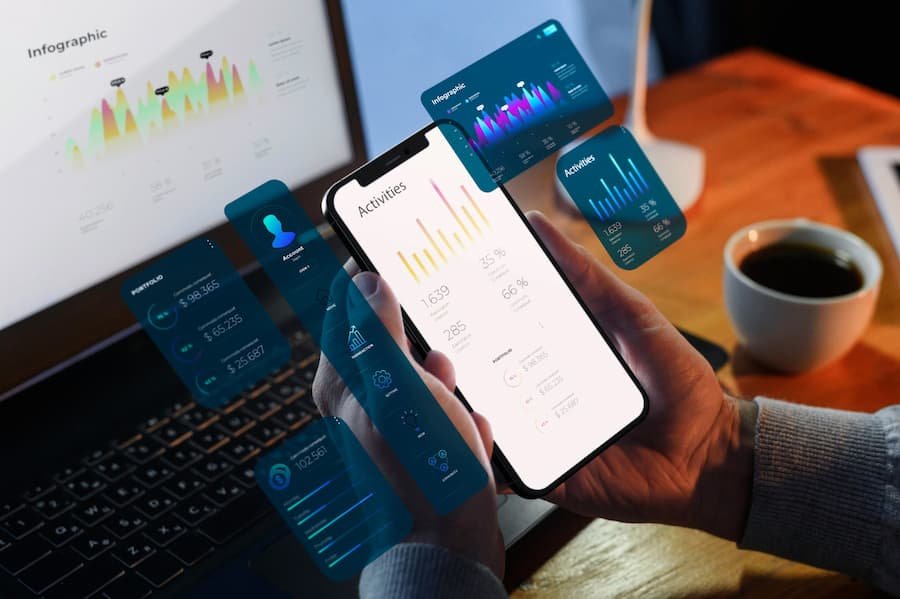
Even though mobile devices currently account for over 60% of worldwide web traffic, many websites continue to offer an unpleasant mobile experience, slow loading, tiny buttons, horizontal scrolling, and content that won’t fit the screen. Ready-to-use templates often claim to be responsive, but they prioritise desktop layouts and then shrink them rather than designing with mobile users in mind. The opposite strategy is employed in custom web design.
It ensures that all components, including pictures, fonts, navigation, and forms, are optimised for touch, speed, and viewport size by starting with the smallest screen and working its way outward. This approach, which prioritises mobile devices, results in lower bounce rates, higher conversions, and quicker load times. Web designing and development services provide custom solutions tailored to actual user behaviour for businesses looking for a competitive edge.
Not desktop shrinkage, but Mobile-First Architecture
Media queries then cause elements to squeeze, stack, or vanish on a phone after template-based designs are designed on a 27-inch display. This procedure is reversed by custom web design. Designers prioritise creating wireframes for the smallest displays (typically 320px wide) before gradually improving them for tablets and desktop computers.
This prevents crucial information like headlines, call-to-actions, and contact details from ever being relegated to a mobile view that users have to zoom in on to read. Navigation is easy from the beginning, not concealed by a badly written hamburger menu. Instead of a forced adjustment, the outcome is a website that seems natural to the phone. The uncomfortable pinch-to-zoom and sideways scrolling that plague template sites are eliminated by a mobile-first design.
Improved Navigation And Touch Targets
Fat-finger faults happen when press targets (buttons, links, form fields) are under the minimal 44×44 pixels suggested by Apple. Many template sites have buttons designed for desktop computers, which require users to zoom in or aim carefully. This is a point of friction that lowers conversion rates. Bigger, more widely spaced touch targets are created by bespoke design builds.
Menus are designed for thumbs, putting important activities close to the user’s right thumb (for users who are right-handed). To prevent mis-taps, expandable accordions take the place of dropdowns. Forms employ larger input fields and optimised keyboards (e. g., number pad for phone fields). These design decisions decrease abandonment rates, accelerate job completion, and lessen input mistakes.
Quicker Load Times Using Leaner Code
Template sites are stuffed with unused CSS, superfluous plugins, and JavaScript libraries intended to accommodate all conceivable scenarios. This bloat immediately hurts mobile performance, which is typically characterised by slower network speeds and less powerful CPUs. Only the code required for your specific functionality is written by a custom web designer. Developers maximise photos (WebP format, responsive srcsets), delay offscreen scripts, and eliminate render-blocking resources.
Compared to template equivalents, which typically take 4–6 seconds, a custom site frequently loads in 1-2 seconds on 4G. Google considers mobile load speed when determining rankings, with faster websites receiving higher rankings and, as a result, more organic traffic. The mobile experience is enhanced by every byte saved.
Future-Ready, Adaptable Grids
Responsive design is a never-ending process since new gadgets with different screen dimensions are constantly being introduced. Flexible grid systems based on relative units (percentages, viewport width) are used on custom websites instead of fixed pixels. Without breaking, content automatically reflows.
Fluid pictures scale inside their containers without spilling over. This preparation for the future guarantees that your site will appear planned and not broken when a new tablet size or foldable phone is introduced. Breakpoint-based design is used by template websites, which tie them to certain devices (e. g., iPhone 12), leaving holes for other sizes. Custom grids ensure steady behaviour across the constantly growing universe of mobile displays.
Content that has been streamlined and is suitable for mobile devices
Multi-column layouts, big data tables, and long paragraphs, as well as anything that functions on a desktop monitor, become too much on a small screen. A content audit tailored for mobile is included in custom web design. The lengthy material is separated into brief paragraphs and readable subheadings. Statistics or card layouts are used in place of tables. Swipeable carousels or load-on-scroll grids may be found in large galleries.
Users may locate what they need without having to read and scroll endlessly since this simplification lowers cognitive burden. Less data and quicker loading are other benefits of simplified content. Does this feature provide value on a phone? Thi is the question raised by a unique design. Otherwise, it is eliminated.
Conclusion
Custom web design improves mobile performance by utilising mobile-first design, optimised touch targets, faster load times, adaptable grids, simplified content, sophisticated image optimisation, real-device testing, and continuous monitoring. As the eight points above prove, mobile performance is not an afterthought, but the primary design limitation.
To guarantee that your website complies with current user expectations, businesses without internal competence should invest in professional Web Designing and Development. Lost sales due to a sluggish, unpleasant mobile experience are not more expensive for a custom site over time. Your brand is judged by users in a matter of seconds. Make those seconds count. First, design for mobile.
Visit Mangabat for more informative blogs